Why Change Efforts Collapse Under Cognitive Load
Designing Low-Friction Behaviors That Actually Stick

When I worked as a director of academic operations at a small university, I found myself sitting in a strategy session about a new initiative that I genuinely believed would be effective. The case for change was strong. The problem was real. The solution was thoughtful.
And I felt tired. Not resistant or skeptical. Just tired.
I noticed the small internal calculations. Where will this live? What will I stop doing? What margin do I actually have left? I was already managing delivery pressure, client expectations, and the invisible cognitive load of switching between contexts all day. And that’s just at work! Even a well-designed improvement felt like additional weight.
And then I heard these words. “Marian, you seem resistant to this idea. What are your thoughts?”
That was when I started hearing the word resistance differently.
We tend to interpret hesitation as unwillingness. We call it change fatigue, but we often imply something closer to apathy. If people cared more, they would lean in. If they were more resilient, they would adapt faster. If they were more curious, they would be less resistant.
But what I felt then was not resistance or indifference. I liked the idea. I felt saturation and my sponge was full.
Life is getting all the more saturated as the years pass. Modern work environments are structured around high demand and low recovery. Digital tools fragment attention. AI accelerates expectations. Performance standards rise without a corresponding increase in slack. The result is sustained cognitive strain. Research on burnout shows that when workload is high and recovery is insufficient, exhaustion and disengagement follow predictably.
When a system operates near cognitive capacity, even positive change feels threatening. The nervous system does not categorize initiatives by strategic merit. It registers demand.
This is where many change efforts break down. We design behaviors that require sustained executive function in environments where executive function is already depleted. We ask for careful decision-making, ongoing interpretation, emotional regulation, and continuous context switching while throughput expectations remain unchanged.
If a behavior demands decision-making, continual (even small!) judgment, emotional self-management, and context juggling, it will not stick. Not because people lack discipline, but because the cognitive cost exceeds available bandwidth.
The Fogg Behavioral Model clarifies this dynamic. Behavior occurs when motivation, ability, and prompt converge. If you are unfamiliar with Fogg’s model, know that ability is not representing capability, but is addressing the full context of bandwidth. When ability, or bandwidth, drops, even high motivation cannot compensate. In overwhelmed systems, motivation is often present. Ability is what erodes.
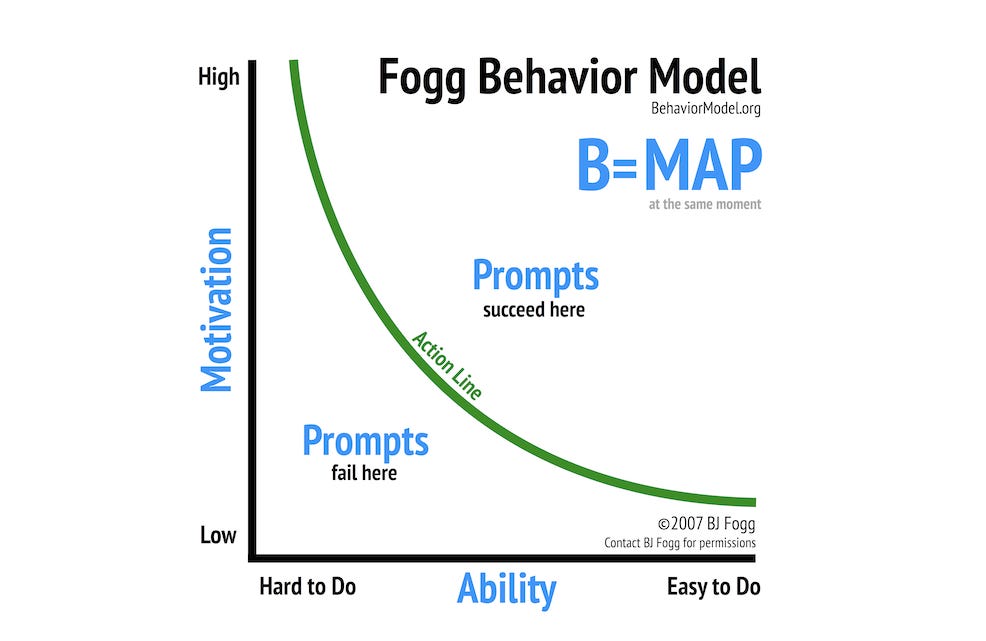
If this bandwidth is the constraint, increasing urgency will not solve the problem. Reducing friction will.
In the Green Path for Change, we respond to overload by shrinking the unit of change. We identify the keystone behavior, the smallest observable action that shifts output. Then we define the microbehavior, the concrete execution step that makes the keystone possible. We introduce one at a time.
So often I see the concept touted as the big solution, and it’s just a matter of implementing it through new directives and standard operating procedures. But in the Green Path, we acknowledge that “solution” as merely the concept that will encapsulate multiple keystone behaviors and many tiny behaviors.
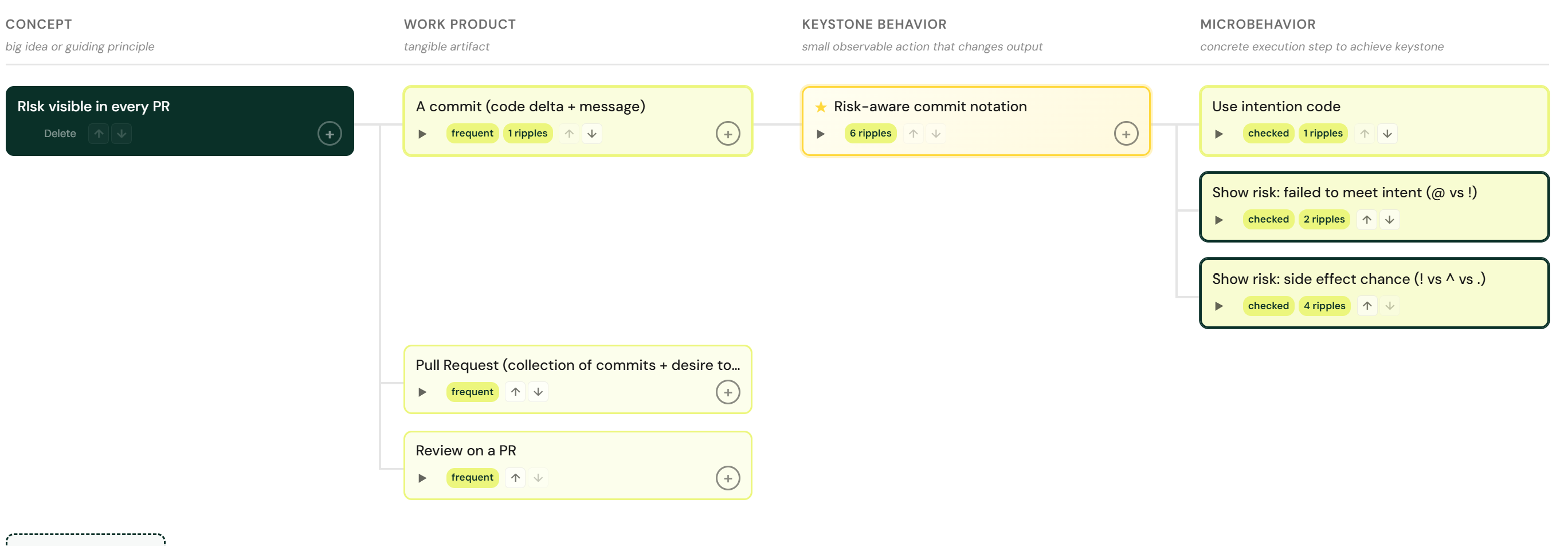
But why note a work product? These tangible artifacts help us create actions that are behavior-first, or in other words, fingers-on-keyboard learning. That grounded learning will get to real change quickly and sustainably.
Even when you choose small observable actions that achieve the concept, those are often too big to drop on people. So we then ask ourselves whether there are even tinier execution steps necessary to achieve that keystone?
These tiny executions are microbehaviors, and should be easy for the user to start. It should create a small but visible win. It should produce a ripple that increases repetition. The aim is not intensity. It is consistency.
Deliberate practice reinforces this approach. Expertise does not grow from broad, exhausting effort. It develops through focused repetition on clearly defined elements with immediate feedback. When the step is small, feedback is fast. Refinement becomes possible without draining limited cognitive resources, as can be seen with these tiny and easily executable microbehaviors for commit notation.
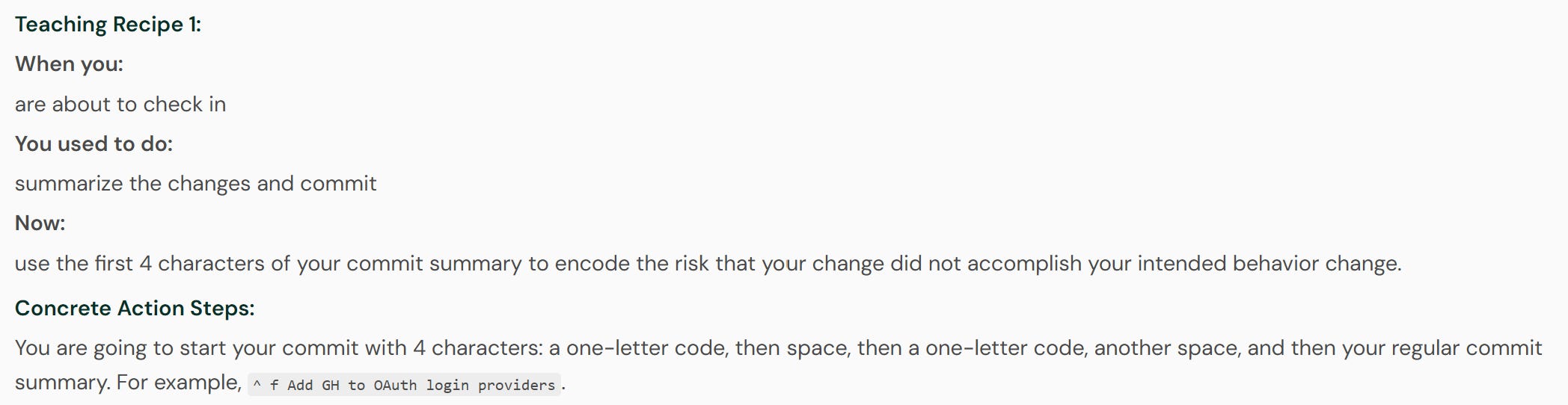
The same simple structure can scale across levels of experience because complexity resides in depth of execution, not in the size of the first move. Those tiny commit notations shows where the risk is in the pull requests. Suddenly we have readable pull requests and risk being caught before going to production.
I have seen ambitious change programs collapse under their own cognitive weight. Meanwhile, I have also seen a single low-friction adjustment shift the tone of an entire team. When friction increases, consistency collapses.
If something stops happening, that is a signal to look closer, not push harder.
Where is the step too large?
Where is interpretation too open-ended?
Where is executive function being required?
Tiny, repeatable actions outperform ambitious yet fragile ones because they respect human bandwidth. They remove the need for constant cognitive heroics. They make success more likely than failure.
Change fatigue tell us that the system needs a different design.
So if you want momentum, stop designing change that depends on willpower.
This is not lowering the bar; it is the only way to clear the bar.