
Stop Explaining, Start Changing Something Small
The moment worth noticing and the move that comes after it.

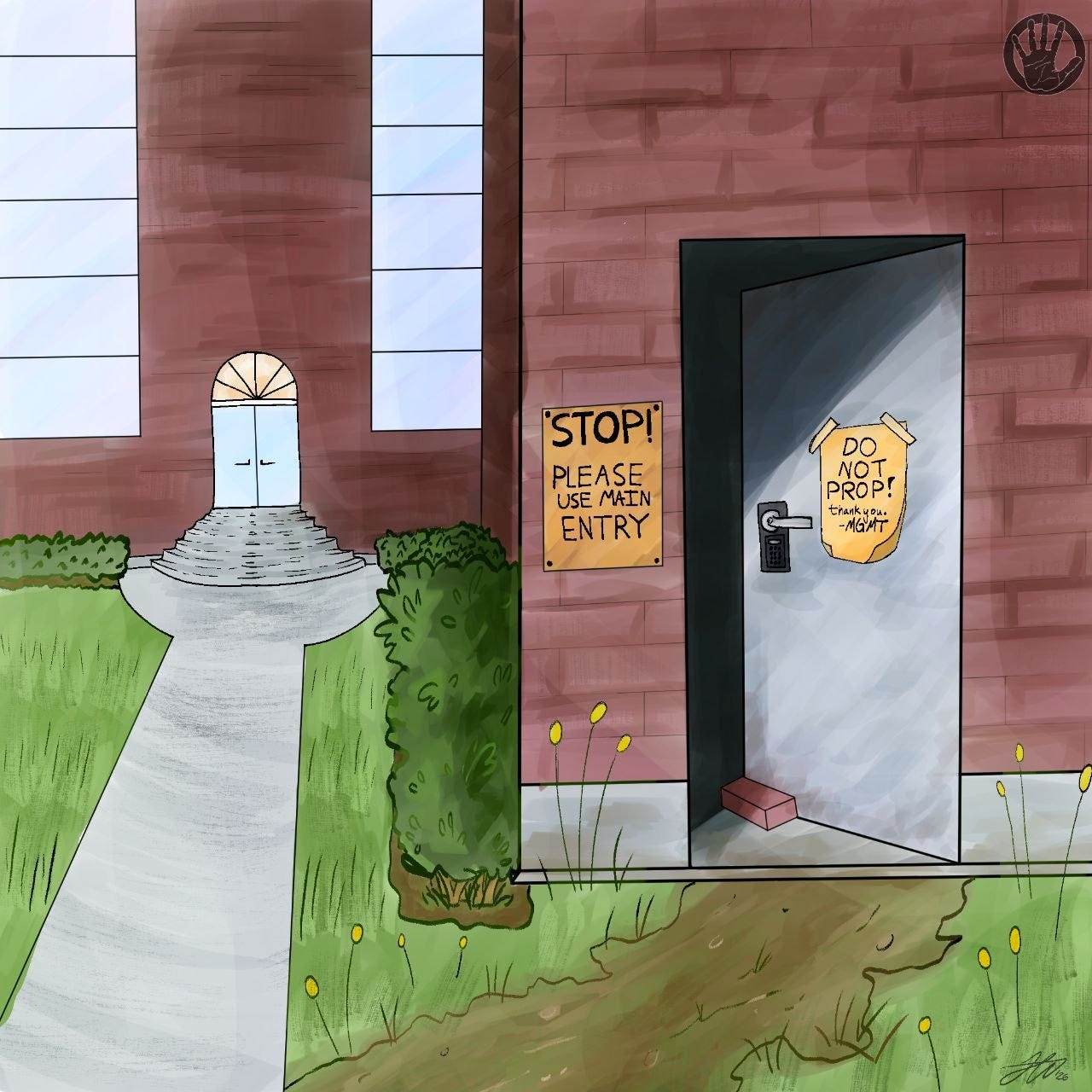
We see this every day.
A sign says “use main entrance.” The path to that entrance is longer, slower, or less convenient. So people use the side door instead. The door locks when it closes, so a second sign appears: “do not prop.”
Does anyone expect the signs to change the behavior?
Of course not. People are not ignoring the instructions. They are responding to the situation. They take the path that makes the most sense given the conditions in front of them.
The brick under the door is not defiance. It is adaptation.
The same dynamic shows up at work, but it is easier to miss.
A manager I know had explained the same thing to every new hire for two years. When a client request came in, it was to be routed to the shared inbox first. It was not to go to her or the team. It was only to go to the shared inbox, where it could be triaged, assigned, and tracked.
She had a slide for it. She walked through it in the first week, and explained how requests that skipped the inbox fell through the cracks, created duplicate work, and frustrated clients. Everyone nodded. It made complete sense.
And within three weeks, without exception, each new hire had gone around the inbox at least once.
So she would explain it again.
This impulse is natural. When something is not working, and you have clarity about why, the obvious move is to transfer that clarity. A cleaner message. A better framing. A conversation that finally makes it land.
But there is a specific moment where explanation stops being the lever. Learning to recognize it changes what you reach for next.
The signal is easy to miss, but very clear: you have explained this before.
Maybe the explanation wasn’t in those exact words, but the substance was there. The expectation was stated. People understood it, at least in the room. And now the same behavior has appeared again.
When that happens, more explanation will not fix it. Not because people are not listening, but because what someone hears in the moment of an explanation is not what they encounter in the moment of the work. Those are different situations, shaped by different conditions. A message delivered in a meeting cannot change what happens at the point where the decision actually gets made.
A message delivered in a meeting cannot change what happens at the point
where the decision actually gets made.
The gap between understanding something and finding it easy to do is not a knowledge gap. It is a structural one.
This is what the last few weeks have been pointing toward. The pattern that shows up across different people is not produced by people who forgot or stopped caring. It is produced by conditions that keep making the same move the most workable option. Following that pattern back to where the work itself changes is where the leverage actually lives.
Once that becomes visible, a different move opens up.
Instead of reaching for clarification, look for one small thing in the work that could be different. Not a new process or additional training. Instead go for something smaller, such as a change in when information arrives, a step that is removed, or something made visible that was easy to overlook.
This is what I call a keystone behavior. It is a small, structural change that shifts what the obvious next move becomes. Now we don’t have to default to the mindset of “try harder” because the work stopped making the harder thing necessary.
The manager eventually made one change. She added the shared inbox as the default destination for new client emails. It was a single routing rule, configured during account setup on day one. The requests started arriving in the inbox because that was simply where they went now. The explanation she had refined for two years became unnecessary.
Nothing else changed.
This week, notice the moment where you want to explain something again. Pause before you draft the message.
Ask yourself instead what one small thing in the work itself could you change?
That is where to start.
